Why Do We Celebrate Guru Purnima – Meaning, History and Significance
“Gurur Brahma, Gurur Vishnu, Gurur Devo Maheshwarah,
Gurur Sakshat Parabrahma, Tasmai Shri Gurave Namah.”
Meaning: The Guru represents Brahma, Vishnu and Maheshwara. The Guru represents the Supreme Being. We offer our salutations to that Guru.
Every year, on the full moon day of the Hindu month of Ashadha, we celebrate Guru Purnima to honour our Gurus, teachers and spiritual guides.
For some of us, a Guru is a spiritual teacher. For others, it may be a schoolteacher, a mentor, a parent or someone whose guidance changed our lives. The relationship may take different forms, but one feeling remains at the heart of Guru Purnima — gratitude towards the person who showed us the way.
In 2026, Guru Purnima falls on Wednesday, 29 July.
But why do we celebrate Guru Purnima on Ashadha Purnima? Why do we remember Maharishi Vyasa on this day? And what makes the relationship between a Guru and a Shishya so important in Indian tradition?
Let us understand the meaning, history and significance of Guru Purnima.
🪔 What Does Guru Purnima Mean?
The Sanskrit word Guru refers to a teacher, guide or spiritual preceptor.
A well-known traditional interpretation explains the word through two syllables — Gu, which represents darkness or ignorance, and Ru, which represents its removal.
In this sense, a Guru guides a person from ignorance towards knowledge and understanding.
Purnima means the full-moon day of the lunar month. Guru Purnima falls on the Purnima of Ashadha, which usually comes in June or July.
The full moon also gives us a beautiful way to understand the meaning of this day. Just as light removes darkness, knowledge removes ignorance and confusion.
Guru Purnima, therefore, celebrates knowledge, wisdom and the people who guide us towards them.
🪔 Why Is Guru Purnima Also Called Vyasa Purnima?
At the centre of Guru Purnima in Hindu tradition stands Maharishi Krishna Dvaipayana Vyasa, better known as Ved Vyasa.
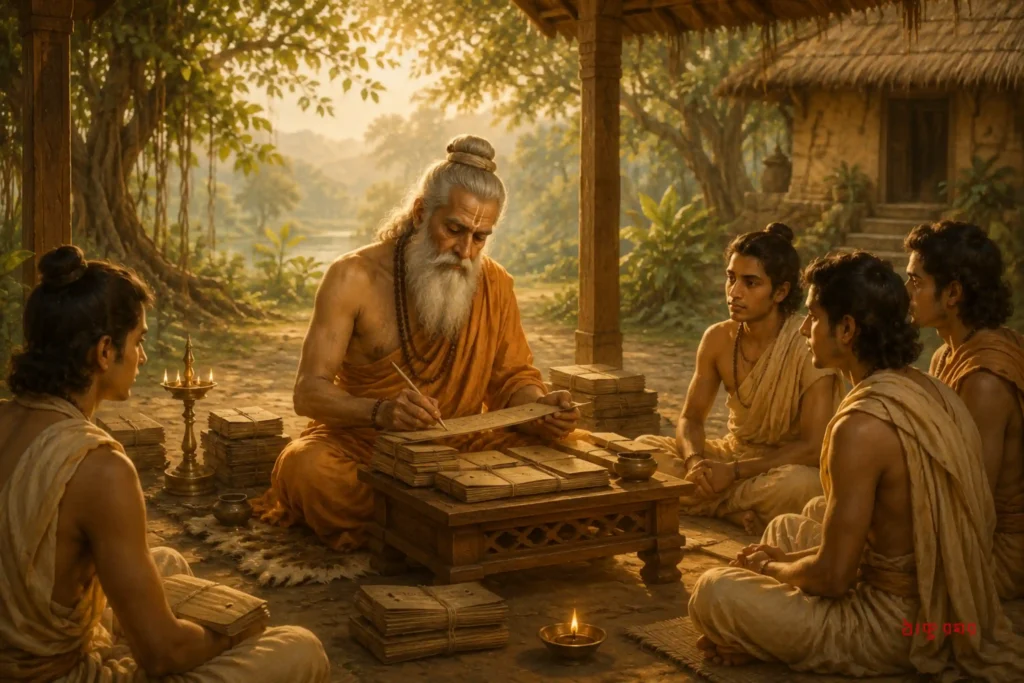
According to Hindu tradition, Maharishi Vyasa was born on Ashadha Purnima. For this reason, people also know the day as Vyasa Purnima.
Ved Vyasa holds a very important place in Hindu tradition. Hindu tradition credits him with organising the Vedic knowledge into the four Vedas — Rigveda, Yajurveda, Samaveda and Atharvaveda.
He also has a deep association with the Mahabharata, which contains the Bhagavad Gita. Hindu tradition also connects him with the Brahma Sutras and the Puranic tradition.
Vyasa did not simply possess knowledge. He helped preserve and pass it on to future generations.
That makes his connection with Guru Purnima especially meaningful.
When we honour Maharishi Vyasa on Guru Purnima, we also honour the long line of teachers who have carried knowledge from one generation to another.
🪔 Lord Shiva as Adi Guru
Another tradition connects Guru Purnima with Lord Shiva.
Several yogic, Shaiva and Tantric traditions honour Lord Shiva as Adi Guru, or the primordial Guru.
A widely known yogic tradition tells us that Shiva shared his knowledge with the Saptarishis, the seven great sages. The Saptarishis later carried this wisdom in different directions and helped continue the tradition of spiritual and yogic knowledge.
Different traditions tell this story in slightly different ways. However, the central thought remains closely connected with the spirit of Guru Purnima.
Knowledge becomes more meaningful when we share it with others.
For many followers of yoga and Shaiva traditions, Guru Purnima therefore becomes a day to honour both their personal Guru and the long lineage of teachers who came before them.
🪔 Guru Purnima and Buddha’s First Teaching
The full moon of Ashadha also holds great importance in Buddhism.
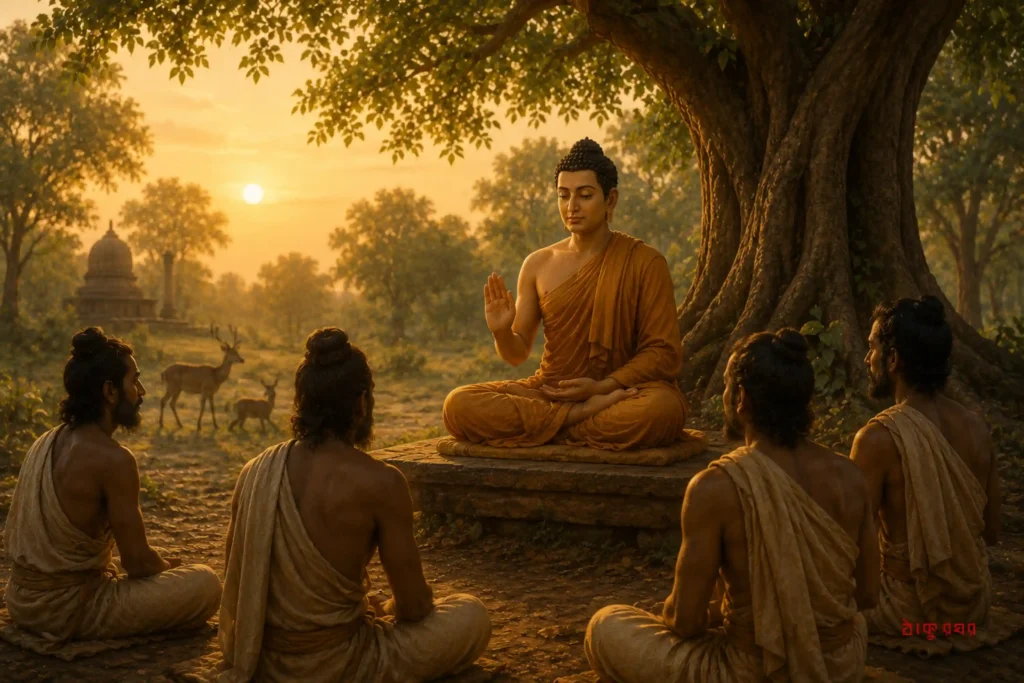
According to Buddhist tradition, after attaining enlightenment, Gautama Buddha travelled to the Deer Park at Sarnath, near present-day Varanasi.
There, he gave his first teaching to five ascetics who had known him before his enlightenment.
Buddhist tradition knows this discourse as the Dhammacakkappavattana Sutta, or the discourse on “Setting the Wheel of Dhamma in Motion.”
In this teaching, Buddha explained ideas that later became central to Buddhism, including the Four Noble Truths and the path that leads away from suffering.
Buddhists remember this important event during the Ashadha full moon.
The connection is also meaningful in the context of Guru Purnima. Buddha did not keep his understanding to himself. He chose to share it with others.
Once again, we find the same idea at the centre — a teacher passing knowledge to those who seek it.
🪔 The Guru-Shishya Parampara
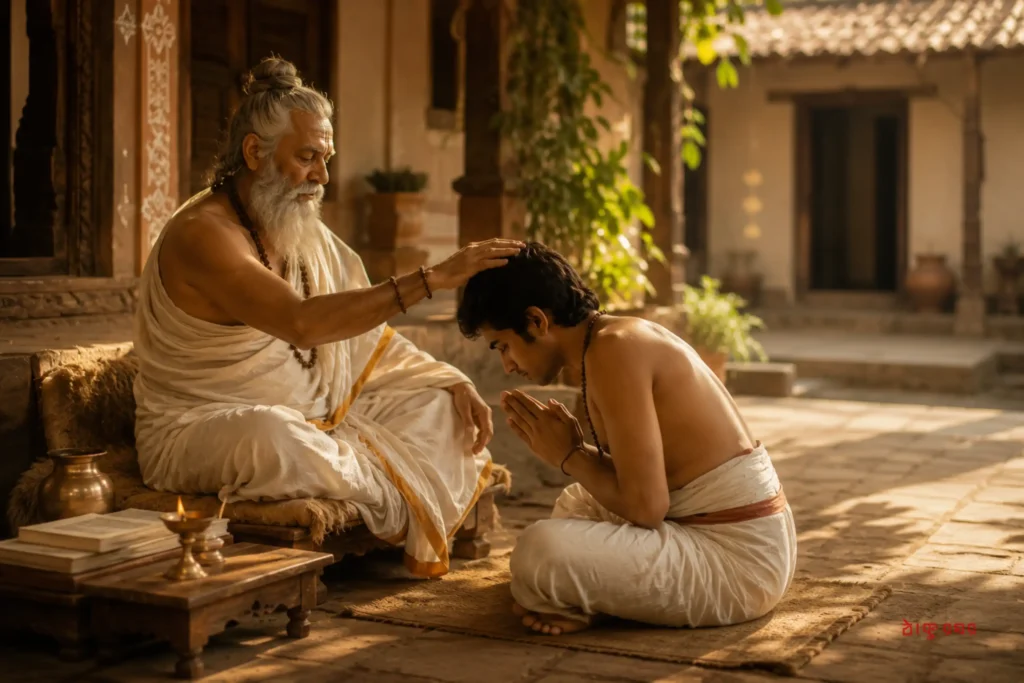
To understand the true meaning of Guru Purnima, we should also understand the Guru-Shishya Parampara — the traditional relationship between a teacher and a disciple.
For centuries, people in India learned much more than what they could find in books.
A Shishya learned from the Guru through teaching, questioning, observation, practice and discipline. In many traditions, the student spent years learning directly under the guidance of the Guru.
The Mundaka Upanishad speaks about approaching a knowledgeable Guru in the search for higher knowledge.
The Bhagavad Gita also explains the relationship between a teacher and a seeker beautifully. Chapter 4, Verse 34 says:
“Tad viddhi pranipatena pariprashnena sevaya,
Upadekshyanti te jnanam jnaninas tattva-darshinah.”
The verse tells us to seek knowledge with humility, sincere questions and service. Those who understand the truth can then share their knowledge with us.
One part of this verse deserves special attention — sincere questioning.
The Guru-Shishya tradition does not ask a student to stop thinking or asking questions. Respect matters, but so does curiosity. A student must have a genuine desire to learn and understand.
The Guru-Shishya Parampara has helped generations preserve Vedic learning, philosophy, yoga, Ayurveda, Indian classical music, dance and many traditional arts and crafts.
Even today, the word Guru means something more than simply “teacher”.
A teacher can give us information.
A Guru helps us understand it.
🪔 How Do People Observe Guru Purnima?
People do not follow one single method to celebrate Guru Purnima.
Customs vary between families, spiritual lineages, ashrams and sampradayas. However, respect, gratitude and remembrance remain at the heart of the occasion.
In ashrams and spiritual centres, disciples may gather for Guru Puja, bhajan, mantra chanting, meditation or spiritual discourses.
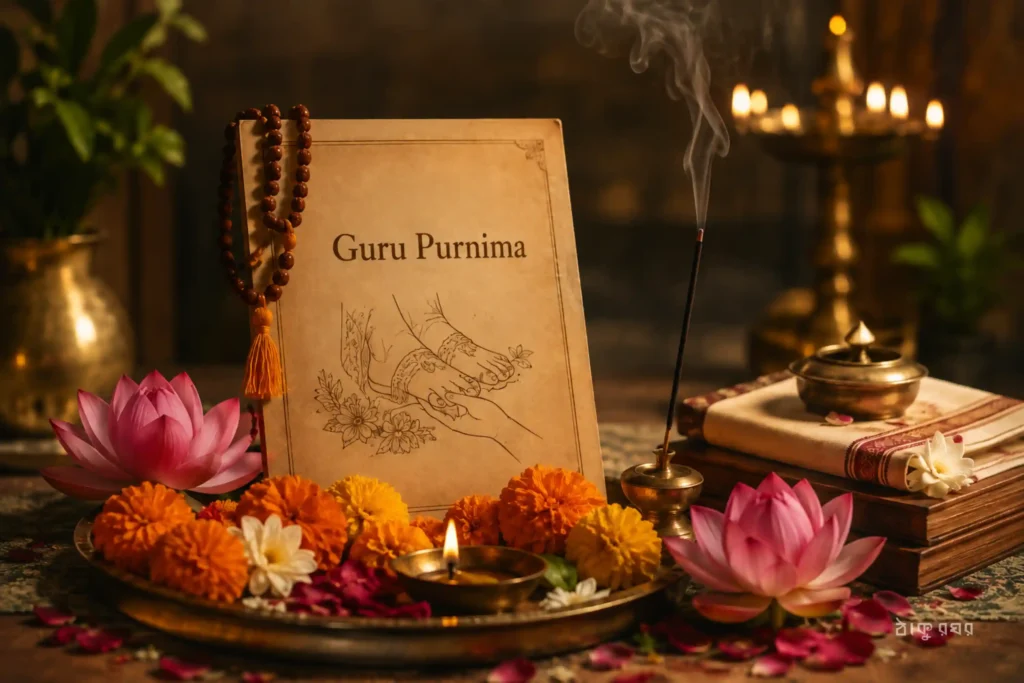
Some traditions also perform Paduka Puja as a mark of respect towards the Guru.
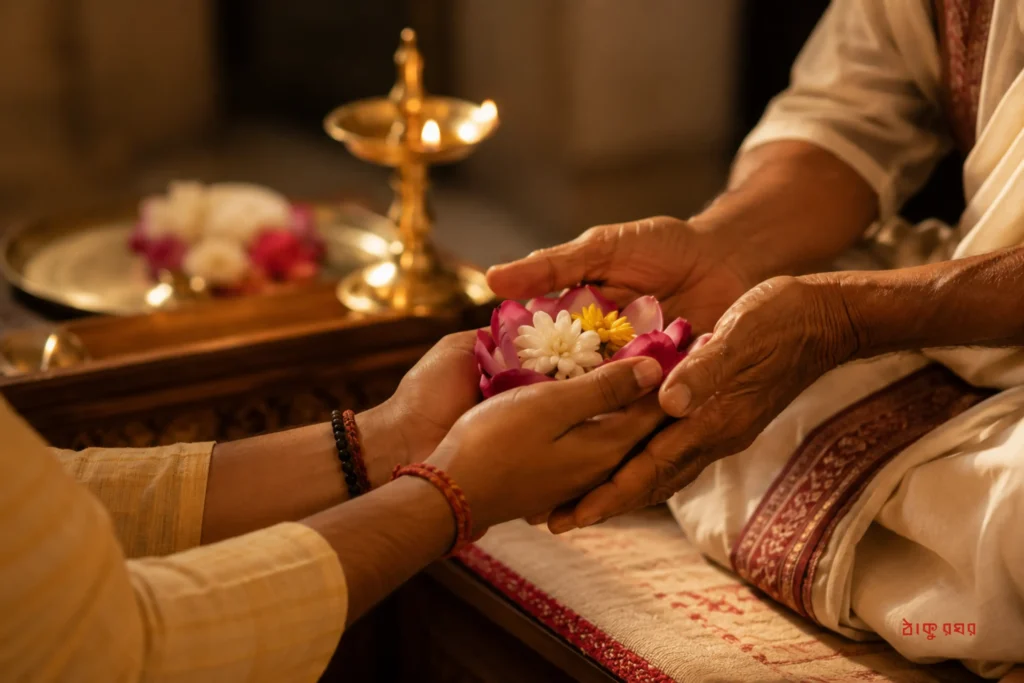
Students of classical music, dance and other traditional arts may visit their Gurus and offer flowers, fruits or Guru Dakshina.
Families can also observe Guru Purnima in a simple way at home. They may light a diya, offer flowers and fruits, recite a Guru Vandana and spend some quiet time remembering their teachers and elders.
You do not need an elaborate ritual to express gratitude.
The intention behind the offering matters more than its size.
🪔 What Can You Offer on Guru Purnima?
There is no compulsory list of Guru Purnima puja samagri that every family must follow. Traditions and customs differ. For a simple observance at home, you may offer:
- Fresh flowers
- Fruits
- Sweets or prasad
- A diya
- Dhoop or agarbatti
- Chandan
- Guru Dakshina, if appropriate
Those who visit a living Guru may also offer clothes, fruits or another respectful gift according to their tradition.
If your Guru, family or sampradaya follows a particular puja paddhati, you should follow that tradition.
Most importantly, Guru Purnima does not depend on the number of items you offer.
Even a single flower offered with genuine respect can carry deep meaning.
For a simple home puja, you can also keep your daily puja essentials ready beforehand so that you can spend the occasion peacefully without worrying about last-minute arrangements.
🪔 Guru Purnima in Bengal
Bengal has a deep connection with the idea of the Guru.
We can see the Guru-Shishya relationship across Bengal’s spiritual traditions, Vaishnava lineages, classical music, traditional arts and the Baul tradition.
The Guru holds an especially important place in Baul philosophy.
Baul teachings often give importance to personal spiritual experience and direct guidance from the Guru. Here, the Guru does not simply explain religious texts. The Guru guides the seeker through personal experience and spiritual practice.
Bengal’s Vaishnava traditions also give great importance to spiritual guidance and the continuation of teachings through a Guru.
Outside religious traditions, we can easily see the Guru-Shishya relationship in Bengali music and performing arts.
Many singers, musicians and dancers learn directly from their teachers for years. Often, that relationship continues long after the formal lessons end.
This gives us a simple way to understand the Guru-Shishya tradition.
Some lessons come from books. Some lessons can only come from people.
Guru Purnima gives us an opportunity to remember those people.
🪔 Why Does Guru Purnima Still Matter Today?
Today, information is available everywhere. We can search for almost anything within seconds, watch tutorials, read books online and learn new skills from our phones. Yet having easy access to information does not always give us wisdom. This is where the role of a good teacher continues to matter.
A teacher does much more than provide answers. They help us ask the right questions, point out our mistakes and guide us when we feel unsure. Sometimes they encourage us when we lose confidence, and sometimes they tell us something we may not want to hear but need to understand. Many of us can probably remember a teacher whose simple advice has stayed with us for years.
This is also why Guru Purnima does not have to be only about spiritual Gurus or teachers from ancient traditions. The schoolteacher whose lessons you still remember, the music teacher who patiently corrected your mistakes, a mentor who guided you during an important stage of your career, or a parent or grandparent who taught you through their own actions — each of them may have shaped your life in a different way.
Not every Guru wears saffron robes. Sometimes, the people who guide us are already part of our everyday lives. Guru Purnima gives us an opportunity to remember them, acknowledge what we have learned from them and, most importantly, express our gratitude.
🪔 The Guru Within
Some Indian spiritual traditions also encourage us to understand the idea of the Guru at a deeper, more personal level. In Advaita teachings, for example, the Guru guides the seeker on the path towards self-knowledge. The teacher helps us look beyond our usual thoughts and assumptions and gradually develop a clearer understanding of ourselves.
Sri Ramana Maharshi also spoke about the Guru in relation to the Self and inner spiritual understanding. From this perspective, the Guru does not simply give us knowledge from outside. A true teacher also helps us recognise and understand what lies within us.
Guru Purnima can therefore become a day of personal reflection as well as a day of worship. We can think about what our teachers have taught us, which of those lessons we still follow and whether we have ever properly thanked the people who guided us. We can also ask ourselves something equally important: when someone looks to us for guidance, do we share what we know with the same patience and sincerity?
In this way, Guru Purnima is not only about remembering the knowledge we have received. It also reminds us to value that knowledge, practise it in our own lives and pass it on when we get the opportunity.
🪔 A Simple Way to Observe Guru Purnima at Home
You do not need an elaborate arrangement to observe Guru Purnima at home. You can begin by cleaning your puja space and preparing a simple place for prayer. If you follow a spiritual Guru, you may place a photograph of your Guru there. Otherwise, you can follow your usual family tradition and worship your Ishta Devata.
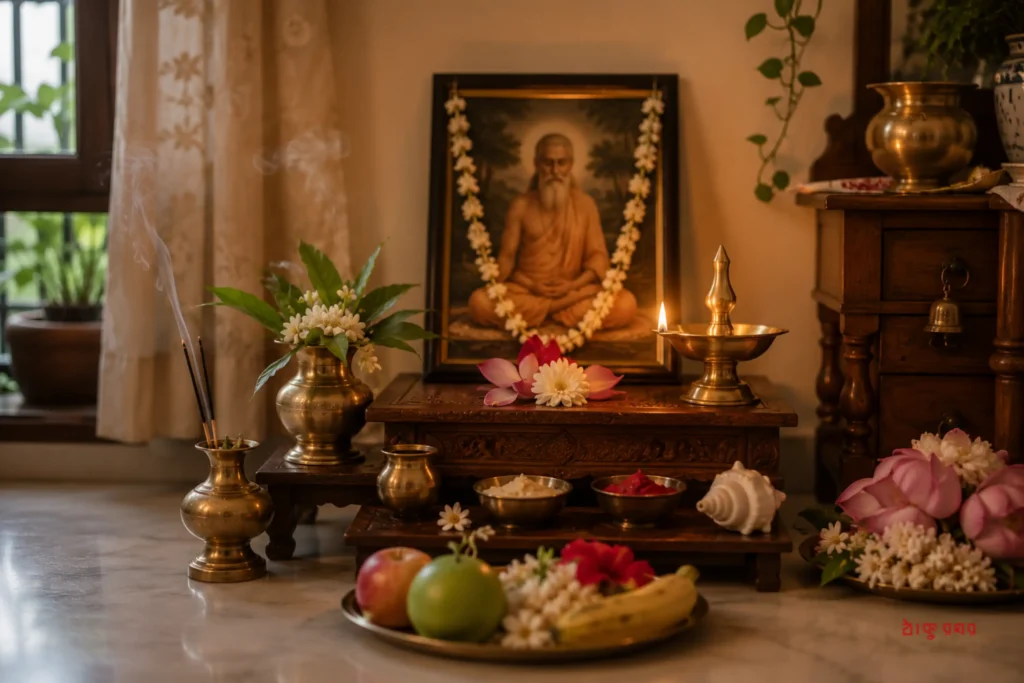
Light a diya and offer fresh flowers. You may also offer fruits, sweets, chandan, dhoop or agarbatti and other puja items that you normally use at home. You can then recite the Guru Vandana, Guru Stotram or another prayer that your family or spiritual tradition follows.
After the prayer, spend a few quiet moments remembering the people who have guided you and the lessons you have received from them. Guru Purnima can also be a good occasion to call or visit a teacher, mentor or elder and thank them personally. Even a simple heartfelt message can be a meaningful way to express your gratitude.
There is no need to make the occasion complicated. Different families and spiritual traditions may follow their own customs, and you should always give preference to those practices. The purpose of a simple Guru Purnima observance at home is to remember your teachers and express your respect and gratitude with sincerity.
🪔 Guru Purnima Is Ultimately About Gratitude
Behind the stories of Maharishi Vyasa, the Guru-Shishya Parampara and the different traditions connected with Guru Purnima lies a very simple thought: none of us learns entirely alone.
Someone taught us our first words, answered our questions and corrected us when we made mistakes. At different stages of life, someone may have shown us a better path when we could not find one ourselves. Those teachers also received much of their knowledge from the people who came before them. In this way, knowledge continues to travel from one person to another and from one generation to the next.
Guru Purnima gives us an opportunity to recognise this journey and remember the people who became a part of it. You may perform a traditional Guru Puja, visit your Guru or teacher, light a diya at home or simply call someone whose guidance made a difference in your life and say, “Thank you.” The way you express your gratitude can be simple; what matters is that you mean it.
As we celebrate Guru Purnima, perhaps the most meaningful thing we can do is remember what our teachers gave us and try to carry those lessons forward in our own lives.
From all of us at Thakurghor, wishing you and your family a peaceful and blessed Guru Purnima.
🪔 Frequently Asked Questions (FAQs)
➤ When is Guru Purnima in 2026?
Guru Purnima falls on Wednesday, 29 July 2026. The festival takes place every year on the full-moon day of the Hindu month of Ashadha.
➤ Why is Guru Purnima also called Vyasa Purnima?
Hindu tradition associates Ashadha Purnima with Maharishi Ved Vyasa. For this reason, people also call Guru Purnima Vyasa Purnima. Ved Vyasa holds an important place in Hindu tradition because of his contribution to the preservation and transmission of sacred knowledge.
➤ Why do we celebrate Guru Purnima?
We celebrate Guru Purnima to honour our Gurus and express gratitude for their knowledge and guidance. The day also honours the larger Guru-Shishya tradition through which generations have passed knowledge from teacher to student.
➤ Who can we honour on Guru Purnima?
Traditionally, people honour their spiritual Guru on Guru Purnima. We can also use the occasion to thank teachers, mentors and elders whose guidance has played an important role in our lives.
➤ How can I observe Guru Purnima at home?
You can keep the observance simple. Clean your puja space, light a diya, offer flowers or fruits and recite a Guru Vandana or prayer. You can also spend a few quiet moments remembering your teachers and expressing gratitude for their guidance.
➤ What can I offer on Guru Purnima?
Different traditions follow different customs. For a simple home observance, you may offer flowers, fruits, sweets or prasad, a diya, dhoop or agarbatti and chandan. If your Guru or family follows a particular tradition, follow that practice first.